How Many Tokens Is a Word? We Measured It
About 1.3 tokens per English word on OpenAI's current tokenizer, so 1,000 words is roughly 1,300 to 1,400 tokens. In our 6 Nov 2026 test with o200k_base, English fiction came to 1.32 tokens per word and a technical article to 1.39. Spanish took 1.42, TypeScript 2.2 and JSON 4.1.
On this page
How many tokens is one word?
About 1.3 on OpenAI's current tokenizer, for ordinary English. We ran five samples through o200k_base, the encoding GPT-5, GPT-4.1, GPT-4o and o3 bill with, and through the older cl100k_base. English fiction came to 1.32 tokens per word, a technical article to 1.39. OpenAI's own rule of thumb, 0.75 words per token, works out to 1.33, so it holds for plain prose.
| Sample | Words | Characters | Tokens (o200k_base) | Tokens per word | Tokens per word (cl100k_base) |
|---|---|---|---|---|---|
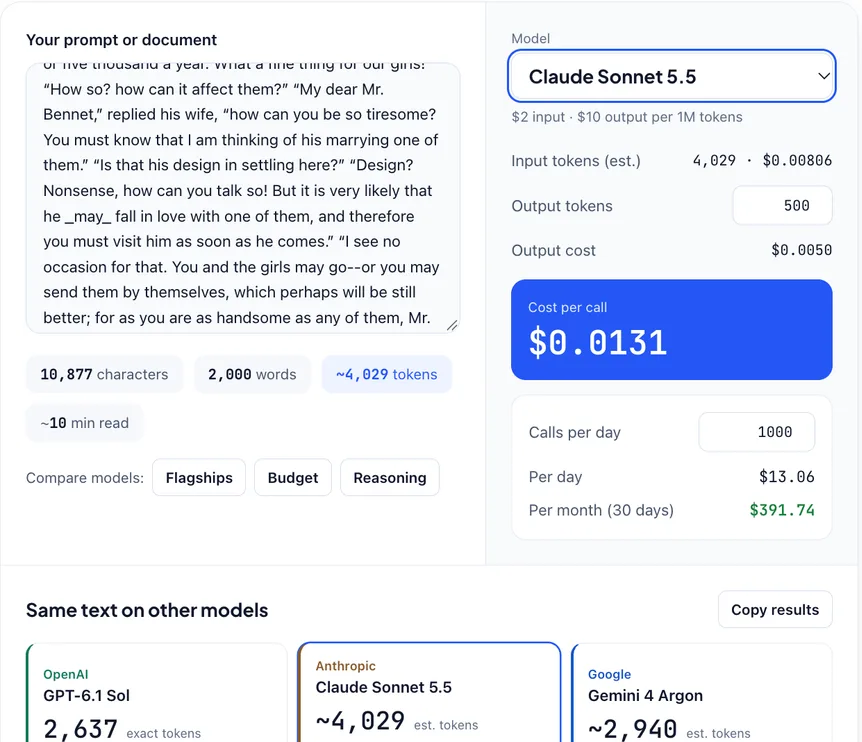
| English fiction | 2,000 | 10,877 | 2,637 | 1.32 | 1.33 |
| English technical article | 1,388 | 8,093 | 1,929 | 1.39 | 1.42 |
| Spanish fiction | 2,000 | 11,045 | 2,848 | 1.42 | 1.63 |
| TypeScript code | 882 | 7,125 | 1,941 | 2.20 | 2.20 |
| JSON | 985 | 12,000 | 4,067 | 4.13 | 4.19 |
Measured 6 Nov 2026 with js-tiktoken 1.0.21. A word is anything between spaces, the same rule our word counter uses. How we picked the samples is at the end.
The technical article costs more per word than the novel because it is full of model names, prices and numbers such as "GPT-5" and "$1.25", and each of those splits into several tokens.
How many tokens is 1,000 words?
Between 1,300 and 1,400 tokens for English on OpenAI's tokenizer: 1,318 for our fiction sample and 1,390 for the article. The same 1,000 words in Spanish came to 1,424 tokens.
Turned around, 1 million tokens holds about 758,000 words of plain English prose, or about 720,000 words of technical writing. For a quick estimate of your own text, multiply its word count by 1.3 for prose and 1.4 for technical writing, or paste it into the OpenAI token counter for the exact number.
Do Claude and Gemini count words differently?
Yes. Gemini matches OpenAI on plain prose but uses 9% to 19% more tokens on technical writing, code and JSON. We sent the same five samples to Google's countTokens method for Gemini 3.8 Flash, which counts tokens without running the model:
| Sample | OpenAI (o200k_base) | Gemini 3.8 Flash | Gemini vs OpenAI |
|---|---|---|---|
| English fiction | 1.32 | 1.29 | 2% fewer |
| English technical article | 1.39 | 1.52 | 9% more |
| Spanish fiction | 1.42 | 1.41 | 1% fewer |
| TypeScript code | 2.20 | 2.56 | 16% more |
| JSON | 4.13 | 4.93 | 19% more |
Tokens per word, measured 6 Nov 2026. Google's own rule of thumb, about 4 characters per token, works for the novel but undercounts the rest: it predicts 1.46 tokens per word for our article, and Gemini counted 1.52.
Anthropic's own figures put Claude above both. It says a token on its earlier models is about 3.5 English characters, and that Claude 4.7 and later produce about 30% more tokens for the same text. We did not run our samples through Claude, so the rows below are estimates: those published ratios applied to our two English samples.
| Model family | Estimate basis | Fiction, tokens per word | Article, tokens per word |
|---|---|---|---|
| Claude 4.6 and earlier | 3.5 characters per token | about 1.55 | about 1.67 |
| Claude 4.7 and later | 30% more than earlier Claude | about 2.0 | about 2.2 |
| This matters for cost. Claude Sonnet 5.5 and GPT-6.1 Sol both list $2.00 per 1M input tokens, but if Claude needs about 2.2 tokens per word of technical text and GPT 1.39, the same document costs Claude users more per word at the same list price. The Claude token counter shows both Claude tokenizers side by side, and the Gemini token counter covers Google's image, video and audio rates. |
Why do code, JSON and other languages cost more tokens?
A tokenizer gives its own token to pieces of text that are common, and common English words are very common, so most of them are a single token. Anything rarer gets split into more pieces. In code, brackets, quotes, dots and indentation tend to become tokens of their own, and long identifiers break into parts. JSON is the extreme case: every key comes wrapped in quotes and followed by a colon, so our sample used 4.13 tokens per whitespace-separated word.
Language matters too, and so does the tokenizer generation. Our Spanish sample needed 1.42 tokens per word on o200k_base but 1.63 on the older cl100k_base, so moving from GPT-4 to a GPT-4o or GPT-5 model cut Spanish token counts by about 12% before any price change.
If a prompt carries a lot of JSON, it is worth trimming keys and whitespace before you send it; our guide to cutting OpenAI API costs covers that and prompt caching.
What does 1,000 words cost to send?
Multiply the token count by the input price per 1M tokens. At 1,390 tokens per 1,000 words of technical English, a model that charges $2.00 per 1M input tokens, such as GPT-6.1 Sol, bills $0.00278 for those 1,000 words. Replies cost more, because output tokens are priced several times higher than input on most models.
| Name | Input, $ per 1M tokens |
|---|---|
| GPT-6.1 SolOpenAI | $2 |
| Claude Sonnet 5.5Anthropic | $2 |
| Gemini 4 ArgonGoogle | $2 |
| Gemini 3.5 Flash LiteGoogle | $0.3 |
| GPT-6 LunaOpenAI | $0.1 |
| Claude Haiku 5.5Anthropic | $0.1 |
Every current model's input, output and cached price is on our LLM API pricing page, and the LLM cost calculator turns a token count and a request volume into a monthly bill.
How we measured
- English fiction: the first 2,000 words of Pride and Prejudice from chapter 1, from Project Gutenberg (public domain).
- English technical article: the full body of our OpenAI cost-cutting guide, 1,388 words.
- Spanish fiction: the first 2,000 words of Don Quijote from chapter 1, also from Project Gutenberg.
- TypeScript code: one source file from this site,
src/data/pricing.ts. - JSON: the first 12,000 characters of one of our pricing snapshots.
Words are counted by splitting on whitespace. OpenAI tokens come from js-tiktoken 1.0.21 with the o200k_base and cl100k_base encodings, which match OpenAI's own tiktoken. Gemini tokens come from the Gemini API's countTokens method for gemini-3.8-flash, which adds nothing of its own: a one-word message counts as 1 token. The script is in our repository as scripts/measure-tokens.mjs, so anyone can rerun it, and it adds Claude and Gemini counts from their free token-counting APIs when keys are set. The article and code samples are pages and files from this site, so a rerun on a later version gives slightly different counts for those two; ours come from the 6 Nov 2026 versions.
To check the numbers outside the script, we pasted the fiction sample into our token counter. It gave the same 2,637 tokens for GPT-6.1 Sol.
Sources
- OpenAI, key concepts: tokens (checked 6 Nov 2026)
- Anthropic glossary: tokens (checked 6 Nov 2026)
- Anthropic token counting (checked 6 Nov 2026)
- Google Gemini API, understand and count tokens (checked 6 Nov 2026)
- js-tiktoken 1.0.21 (o200k_base and cl100k_base)
- Project Gutenberg: Pride and Prejudice (sample text)
- Project Gutenberg: Don Quijote (sample text)
Frequently asked
How many tokens is 1,000 words?
About 1,300 to 1,400 tokens for English on OpenAI's o200k_base tokenizer. Our test gave 1,318 tokens per 1,000 words of fiction and 1,390 for a technical article. Spanish came to 1,424, and code or JSON to two to four times the word count.
How many words is 1 million tokens?
Roughly 720,000 to 760,000 English words on OpenAI's tokenizer, based on our measured 1.32 to 1.39 tokens per word. Text with code, numbers or another language gets fewer words per million tokens.
Does Claude use more tokens per word than GPT?
Yes, by Anthropic's own figures. It says a token on earlier Claude models is about 3.5 English characters, against OpenAI's 4, and that Claude 4.7 and later produce about 30% more tokens for the same text. That puts recent Claude models near 2 tokens per English word, as an estimate.
Does Gemini use more tokens than GPT?
On plain English prose, no: Gemini 3.8 Flash counted 1.29 tokens per word of fiction in our test, against 1.32 on OpenAI's o200k_base. On technical writing, code and JSON it used 9% to 19% more, for example 4.93 tokens per JSON word against 4.13.
Why does code use more tokens than prose?
Brackets, quotes, operators and indentation often become tokens of their own, and long identifiers split into several pieces. In our test, TypeScript used 2.2 tokens per whitespace-separated word and JSON 4.1, against 1.3 for English prose.
An independent site run by an AI engineer. Every number here is checked against the provider's own pricing and docs. How we verify.